
Synonyms List
Most repetitive writing comes from a small set of words: good, very, said, big, thing, really. This synonyms list covers about 140 of the most overused words, with alternatives grouped by shade of meaning so you choose the right one, not just a different one. Paste your own text to highlight the overused words it contains and see suggestions next to each.
- Free to use
- No sign-up
- Runs in your browser
Synonyms finder and writing checker
Vocabulary Printables
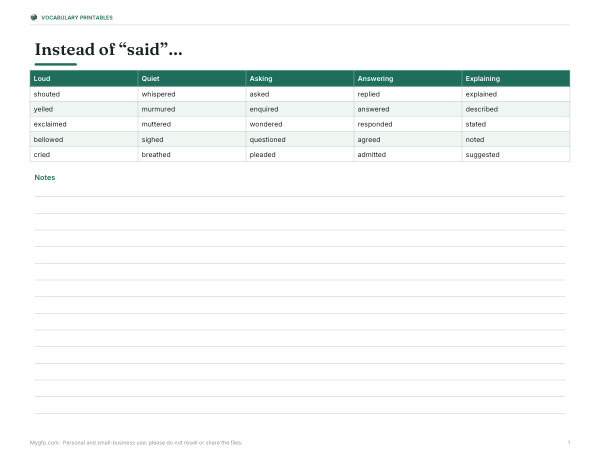
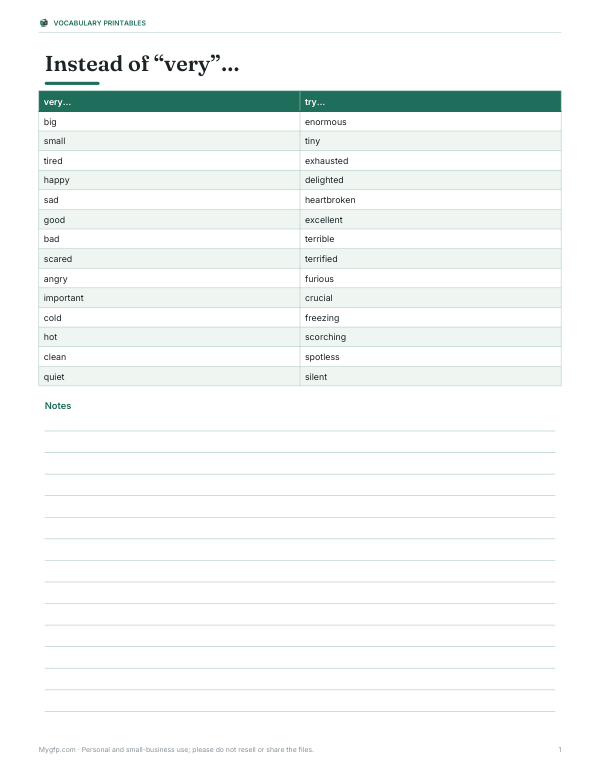
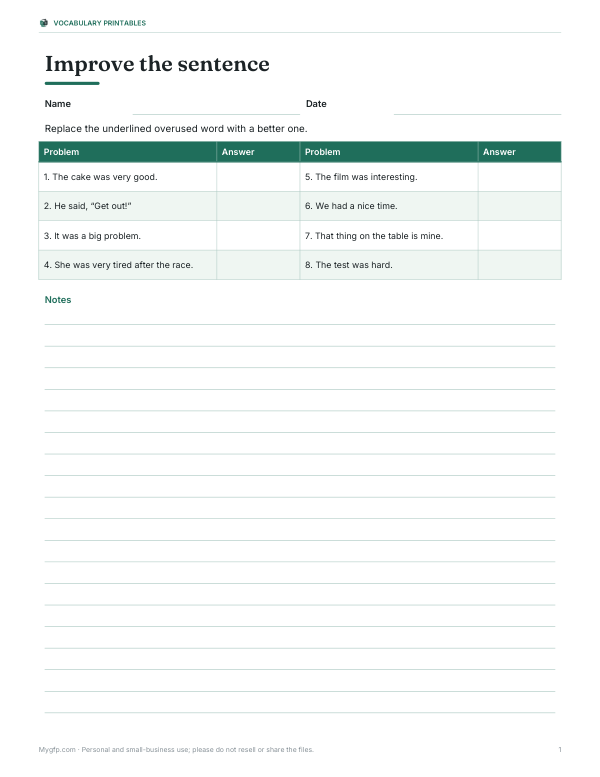
Printable synonyms desk reference for overused words, “said” and “very” replacement posters, and vocabulary worksheets with answer keys.
- “Said” poster (PDF)
- “Very” poster (PDF)
- Synonym worksheet (PDF, DOCX)
Formats: PDF, DOCX. Instant download after payment (link valid 72 hours, up to 5 downloads). AI-assisted: the templates were drafted with AI help and reviewed and laid out before publishing.
$5.00 USD, one-time 3 files · about $1.67 each
- Instant download
- 7-day refund
- Secure checkout by Stripe
7-day money-back guarantee. Full refund within 7 days of purchase, even after you download.
Full refund within 7 days — see the refund policy and license.
Free printables
Single sheets you can print right now, no sign-up. The full pack adds every sheet in one download plus the editable files.
Why choosing the right synonym matters
Synonyms are rarely perfect swaps. “Big” can mean large in size, important, or generous — and the right replacement depends on which. “A big decision” becomes “a major decision”, not “a huge decision”; “a big heart” becomes “a generous heart”. That is why this list groups alternatives by meaning: pick the group that matches your sentence first, then the word that fits the tone.
The most overused words in writing
| Word | Better choices (by meaning) |
|---|---|
| good | excellent, superb · kind, generous · skilled, capable · useful, beneficial |
| very | extremely, highly, remarkably — or a stronger single word (very tired → exhausted) |
| said | explained, replied · whispered, murmured · shouted, exclaimed · argued, insisted |
| thing | item, object · issue, matter · idea, point, factor |
| big | large, vast · major, significant · generous, substantial |
| nice | pleasant, lovely · kind, thoughtful · neat, attractive |
| interesting | fascinating, intriguing, compelling, thought-provoking |
| get | obtain, receive · become · fetch, collect · understand, grasp |
Using the checker
- Paste a paragraph or an essay into the box.
- Overused words from the list are highlighted; hover to see suggestions.
- The summary counts each one and suggests alternatives.
- Replace only where it improves the sentence — some repetition is natural and clear.
- Look up any word in the top box for the full list grouped by meaning.
Worked example
The sample text uses “very” twice, and “really”, “good”, “sad”, “said”, “big”, “nice”, “thing” and “interesting” once each; the checker also flags everyday words such as “think”, “see” and “ending” (listed under “end”), which you can keep where they read naturally. A revision might read: “The film was excellent, and the ending was heartbreaking. She called it a complete surprise, and I found it a thoughtful story to watch. Overall, it was fascinating.” Notice that “very sad” became a single stronger word, “heartbreaking”, rather than “extremely sad”.
Replace “very” with one strong word
| Instead of | Try |
|---|---|
| very big | enormous, huge |
| very small | tiny, minute |
| very tired | exhausted |
| very happy | delighted, thrilled |
| very sad | heartbroken, miserable |
| very good | excellent, superb |
| very bad | terrible, dreadful |
| very scared | terrified |
| very angry | furious |
| very important | crucial, essential |
Tips for richer vocabulary
- Read widely and note words you like in context.
- Prefer precise verbs over adverbs: “sprinted” rather than “ran quickly”.
- Use a synonym only if you know how it is used — check an example sentence in a dictionary.
- Keep technical terms consistent: in reports and instructions, repeating the same term is clearer than varying it.
- Read your writing aloud to catch repetition.
Formal and informal synonyms
Synonyms also differ in register. “Get” is fine in conversation, “obtain” suits a report and “acquire” a formal or legal document. “Kids” is casual; “children” is neutral. In an essay, choose the more formal word; in a story’s dialogue, the casual word may sound more natural. Mixing registers — “The committee got really upset” in a formal report — is a common reason writing sounds uneven.
Synonyms, near-synonyms and connotation
| Neutral | Positive | Negative |
|---|---|---|
| thin | slim, slender | skinny, scrawny |
| careful | thorough, meticulous | fussy, finicky |
| confident | self-assured | arrogant, cocky |
| cheap | affordable, economical | shoddy, tacky |
| old | vintage, classic | outdated, decrepit |
Words with the same basic meaning can carry very different feelings. Check the connotation before you swap: “slender” flatters, “skinny” may not.
Building vocabulary for exams
Examiners reward precise, varied vocabulary used correctly. Learn synonyms in groups by meaning, not as isolated pairs, and practise each new word in a sentence of your own. Replacing three or four vague words in a paragraph with precise ones usually improves writing more than adding rare words. Reading the list aloud and noting which words you already know but never use is a quick way to find your next targets.
Using synonyms in essays and reports
- Don’t vary key terms: if your essay is about “climate change”, keep calling it that.
- Vary linking words instead: however, moreover, therefore, as a result.
- Replace vague words with specific ones rather than with fancier synonyms.
- A thesaurus-heavy style can sound forced; clarity matters more than variety.
About this list
The list covers around 140 common words and phrases with alternatives we grouped by meaning. It is intentionally focused on overused everyday words rather than a complete thesaurus; for rare words, a full dictionary or thesaurus is the better tool. The lookup and checker run in your browser, so your writing isn’t uploaded.
Printable vocabulary pack
The optional pack includes the full synonyms list as a printable desk reference, “said” and “very” replacement posters for classrooms, and vocabulary worksheets with answers. The online list and checker are free to use.
AI-assisted content
The synonym groups and explanations were drafted with AI assistance and reviewed before publishing.
Frequently asked questions
What is another word for good?
Excellent, fine, great, superb — or kind, skilled or useful, depending on meaning.
What can I use instead of “said”?
Explained, replied, whispered, shouted, argued, suggested and more.
How do I avoid using “very”?
Replace “very + adjective” with a single stronger word, such as “exhausted” for “very tired”.
Are synonyms always interchangeable?
No — they differ in meaning and tone, so choose by context.
Is my writing uploaded?
No, the checker runs in your browser.
Can I print the list?
Yes, print the full list in two columns.
What is the difference between a synonym and an antonym?
A synonym has a similar meaning; an antonym has the opposite meaning.
Why are some words listed with several senses?
Because one word can mean different things; pick the sense that fits your sentence.
Does the checker change my text?
No, it only highlights words and suggests alternatives; you decide what to change.